Posts

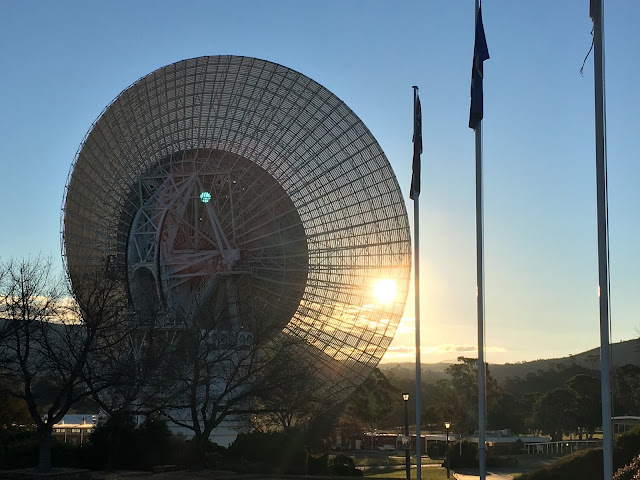
It Takes Over 16 Hours For A Signal Travelling At The Speed Of Light To Get From Earth To The Voyager Spacecrafts
Image
Fact of the day: It takes over 16 hours for a signal travelling at the speed of light to get from earth to the voyager spacecrafts. I personally think that the things achieved in space exploration are the most remarkable achievements in the history of human kind. From the first (non-natural) satellite to orbit the earth, the Russian Sputnik 1 in 1957, to the spacecraft Voyager 1 eventually leaving the solar system in 2012. Having been to the Kennedy Space Centre in Florida and recently visited the Canberra Deep Space Communication Complex (both of which I would recommend to anyone to visit) I have really learnt to appreciate the significance of space exploration. When I was at the Canberra Deep Space Communication Complex, the largest dish in the complex was communicating with one of the Mars rovers, but only a few hours later it would be communicating with Voyager 1, which isn't even in our solar system. I think that is simply mind blowing. (below) The largest dish in the Can...

Fact Of The Week: It Would Take You More Than The Age Of The Universe To Get A Reasonable Chance At Quantum Tunnelling Through A Wall If You Threw Yourself At A Wall Every Second

Image
Fact of the week: It would take you more than the age of the universe to get a reasonable chance at quantum tunnelling through a wall if you threw yourself at a wall every second. Quantum physics describes the world as a sea of probability. You cannot identify the position of an electron in an atom, as it is technically a cloud of probability around the nucleus of an atom. Quantum tunneling is an odd phenomenon where a particle breaks through a barrier, even when it does not have sufficient energy to do so. The probability of a particle, such as an electron, to quantum tunnel is quite high, but as the more massive the object gets, the lower the probability of tunnelling. Its like trying to go through a (closed) door, and you do not have a sufficient amount of energy to go through the door. The ball bounces back because it does not have enough energy to go through the door. Yet somehow it still manages to go, or tunnel, through the door. Quantum tunneling is very important, as i...

The Longest Tail Of A Comet Was Of The Comet Hyakutake, And Was 3.3 AU Long

Image
Fact of the day: The longest tail of a comet was of the comet Hyakutake, and was 3.3 astronomical units long. (above) A Comet from NASA. Comets are small balls of ice and rock, originating in the Oort Cloud and Kuiper belt, and have orbital periods that can range from tens of years to thousands of years. Comets have a very distinctive tail that is caused by the vaporisation of the nucleus of the comet. Comets are always seen with their tail pointing away from the sun, even when the comet is moving away from the sun, as the comets vaporisation is caused by the energy radiating from the sun. Comets have more than one tail, but the one that is the most visible is the tail of gas, and that is always pointing directly away from the sun as it is affected by the solar wind are than the other tails. The other tails are of dust, which are usually curved, and are less visible than the gas tails. Most comets have regular orbits, such as Halley's Comet, which returns to the Earth ...

Over 15000 Tonnes Of Meteorites Fall to Earth Each Year

Image
Fact of the day: Over 15000 tonnes of meteorites fall to Earth each year. Meteors can be the most remarkable sight when viewed at night in a meteor shower. The bright streaks across the sky can be absolutely spectacular. A meteoroid is a rocky or metallic object that could enter the Earth's atmosphere to become a meteor, which can range from the size of grains of sand to one meter across. A meteor is a meteoroid that has entered the Earths atmosphere, and has started to burn up. This incredibly intense friction, or air resistance, usually ends up melting and burning the meteor and then it eventually disintegrates. A meteorite is a meteor that makes it to the surface of our planet. Meteoroids, meteors, and meteorites are usually fragments of various comets and asteroids that happen to be in the Earth's path. (below)* The 60 tonne Hoba meteorite. This landed in Namibia and is the largest intact meteorite known. * Author of the image attribution: By No machine-read...

Ceres Is The Largest Asteroid, With A Diameter Of 945 Km

Image
Fact of the day: Ceres is the largest asteroid, with a diameter of 945 km. It is even classified as a dwarf planet . The asteroid belt lies between Mars and Jupiter. It is between 2.2 and 3.2 astronomical units away from the sun. The objects in it range from hundreds of kilometres wide to dust particles. The asteroids are composed mainly of rock, but some ice has been detected in and on some asteroids. The asteroid belt formed from the remains of the early solar system, and possibly the debris from the collisions of various planetoids. (below) Asteroid Eros from NASA.

The Dwarf Planet Eris Takes 558 Earth Years To Orbit The Sun

Image
Fact of the day: The dwarf planet Eris takes 558 Earth years to orbit the sun. Most dwarf planets are trans-neptunian objects, but some can orbit further inwards, such as Ceres, which orbits in the asteroid belt between Jupiter and mars. Most of the trans-neptunian dwarf planets have highly elliptical orbits, like Eris. The most famous of the dwarf planets is Pluto, as it was previously classified as a planet, but is now classified as a dwarf planet because it did not meet the criteria needed for it to be classified as a planet. These are the criteria: • The object must be in orbit around the sun. • The object has to be massive enough for it own gravity to form it into a round shape. • The object must have cleared the area in its orbit (anything that meets the above criteria but not this one is classified as a dwarf planet). There are five main dwarf planets: Ceres, Pluto, Eris, Haumea, and Makemake. Ceres Ceres is the largest object in the asteroid belt. It is around 9...

Neptune Is The Furthest Planet From The Sun In Our Solar System

Image
Fact of the day: Neptune is the furthest planet from the sun in our solar system. (above) Neptune from NASA Neptune is very similar to Uranus , in both colour, size and composition. Neptune is the last planet in the solar system, at 30.1 astronomical units (4.498 billion km) away from the sun. Neptune is around seventeen times more massive than the Earth, and has a radius of nearly four times that of the Earth's. It has the strongest winds in the solar system, at over 2200 kilometres per hour. That is (just under 1000km/h) faster than the speed of sound on Earth. It is also the coldest planet in the solar system, with temperatures in the atmosphere being at 51.8K (-221.35ÂșC). Neptune radiates over two times as much energy than it receives from the sun, despite its very cold temperatures. It takes Neptune 164.79 Earth years to orbit the sun, and takes 16.1 hours to rotate once in its axis. (below) This is an image of the approximate distances of the planets. The size ...